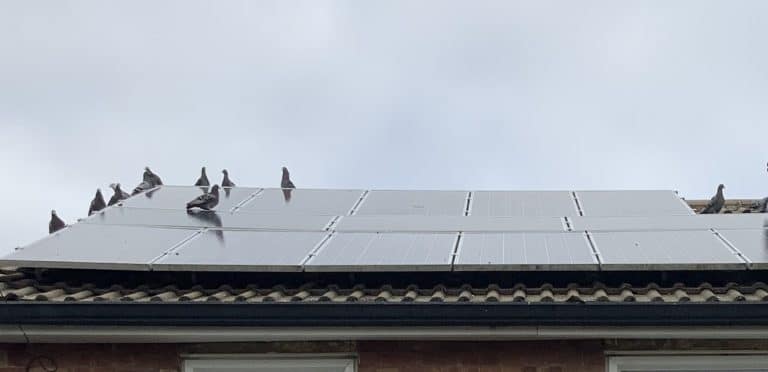
If pigeons have found the gap under your solar panels, they will keep coming back. Here is why it happens, what it costs you if you leave it, and which bird proofing actually works.
Key points
- Yes – most UK homes with roof-mounted panels in towns and cities will attract pigeons sooner or later.
- The sheltered gap under the panels is the problem, not the panels themselves.
- Fitting mesh around the edge of the array is the only reliable long-term fix.
- Professional proofing typically costs £350–£1,200 and comes with a guarantee.
Why pigeons nest under solar panels
Feral pigeons naturally nest on cliff ledges. A modern roof with a solar array gives them something even better: a warm, dry, sheltered space just a few centimetres high, out of the wind and out of sight of predators. Once one pair moves in, others follow, and pigeons can breed several times a year.
The noise usually gives it away first – scratching, cooing and fluttering early in the morning, often right above a bedroom. Then come the droppings on windowsills, patios and cars, and nesting material blocking gutters.
What happens if you don’t bird proof your panels?
- Lost generation. Droppings on the glass shade individual cells, and a shaded cell drags down the output of the whole string.
- Damage to cables and roof. Nesting material, droppings and constant traffic can damage wiring, lift tiles and block gutters, leading to leaks.
- Hygiene. Pigeon droppings carry bacteria and fungal spores and attract mites and insects that can find their way indoors.
- Fire and warranty risk. Dry nest material packed around electrical connections is something installers and manufacturers would rather not see.
- The problem grows. Each breeding season brings more birds and more mess, so the clean-up gets bigger the longer it is left.
Bird proofing options compared
Solar panel mesh (recommended)
Galvanised or PVC-coated steel mesh is cut to fit and clipped to the edge of the panels, closing the gap all the way around the array. It is discreet from the ground, lets air circulate and rain drain away, and needs no drilling into the panels or the roof. Fitted properly, it is the solution most solar installers and bird control specialists use.
Bird spikes
Spikes stop birds landing on ledges, but they do not close the gap under a panel. Pigeons simply land on the tiles and walk underneath. We explain this in more detail in why bird spikes won’t stop pigeons under solar panels.
Scarers, decoys and ultrasonic devices
Plastic owls, reflective tape and ultrasonic boxes may unsettle birds for a few days, but pigeons quickly learn they are harmless. They are not a fix for birds that are already nesting.
How professional pigeon proofing works
- Survey and quote. Send us a few photos and your postcode and we will quote, usually the same day.
- Nest removal. We check for active nests first (all wild birds and their nests are protected by law), then remove nests and debris from under the panels.
- Clean up and treat. Droppings are cleared from under the array and the area is sanitised.
- Fit the mesh. Mesh is cut to size and fixed to the panel frames with clips – no drilling, no damage to your system.
- Guarantee. Our solar panel proofing comes with a 10-year guarantee.
Find out more about our solar panel pigeon proofing service, or see how much pigeon proofing costs. Local pages, such as solar panel bird proofing in Nottingham, explain how it works in your area.
Frequently asked questions
Is it worth bird proofing new solar panels?
Yes. It is far cheaper to proof an array before birds settle in than to remove nests and clean up later. Many owners have mesh fitted at the same time as, or soon after, installation.
Will mesh affect my panels’ performance or warranty?
No. The mesh sits around the edge, not over the glass, and is clipped on rather than drilled, so it does not shade the cells or interfere with the mounting system.
Can I do it myself?
DIY kits are available, but working at height on a roof is dangerous and it is easy to leave gaps or trap a bird inside. A trained team with the right access equipment will do it safely and guarantee the result – see, for example, our solar panel bird proofing in Birmingham.