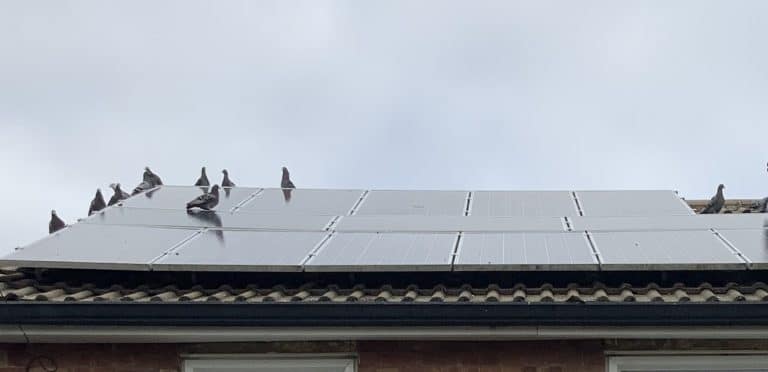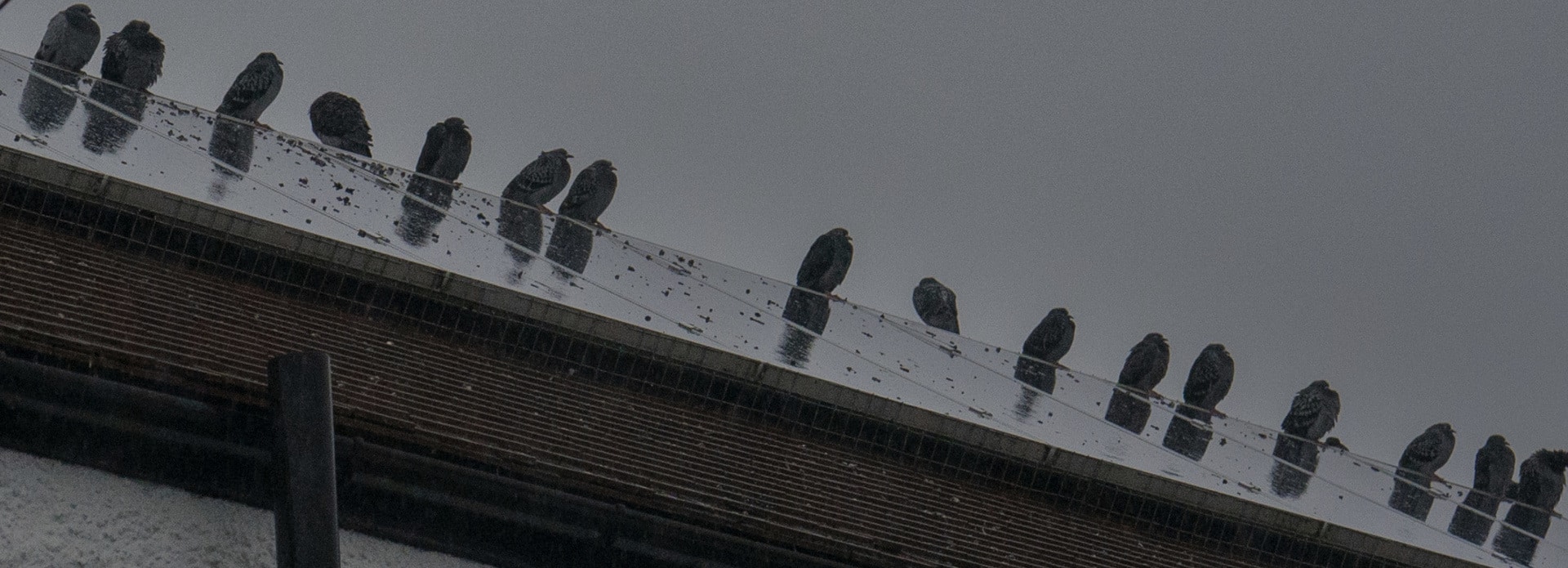
Pigeons under solar panels are one of the most common problems for homeowners with solar in England and Wales. The sheltered gap beneath the array makes a perfect nest site – and once a pair moves in, they rarely leave on their own. This guide explains why it happens, the damage it causes, how long pigeons stay, and how to get rid of them for good.
Key points
- Pigeons nest under solar panels because the gap is warm, dry and safe from predators.
- Feral pigeons can breed all year round, so the problem rarely goes away by itself.
- Nests, droppings and mites can block gutters, damage cables and cut your panels’ output.
- Spikes, fake owls, gels and ultrasonic devices don’t stop pigeons getting underneath.
- The permanent fix is to remove the nests, clean and treat the area, then fit mesh around the array.
Why pigeons nest under solar panels
Feral pigeons are descended from rock doves, which naturally nest on sheltered cliff ledges. A roof-mounted solar array gives them almost exactly the same thing: a flat, hidden ledge with a roof over it. The gap between the panels and the tiles is usually 10–20 cm deep, protected from wind and rain, out of reach of cats and birds of prey, and warmed by the panels above.
Pigeons are also very loyal to a nest site. Once a pair has raised young under your panels, they will return to the same spot again and again – and other pigeons will follow. That is why one or two birds can turn into a colony within a year or two, and why a problem on one house often spreads along a terrace or estate.
It isn’t only pigeons. Collared doves, starlings, sparrows and even squirrels use the same gap, but in towns and cities feral pigeons are by far the most common cause. On homes near farmland, wood pigeons nest under solar panels too.
Signs you have pigeons under your solar panels
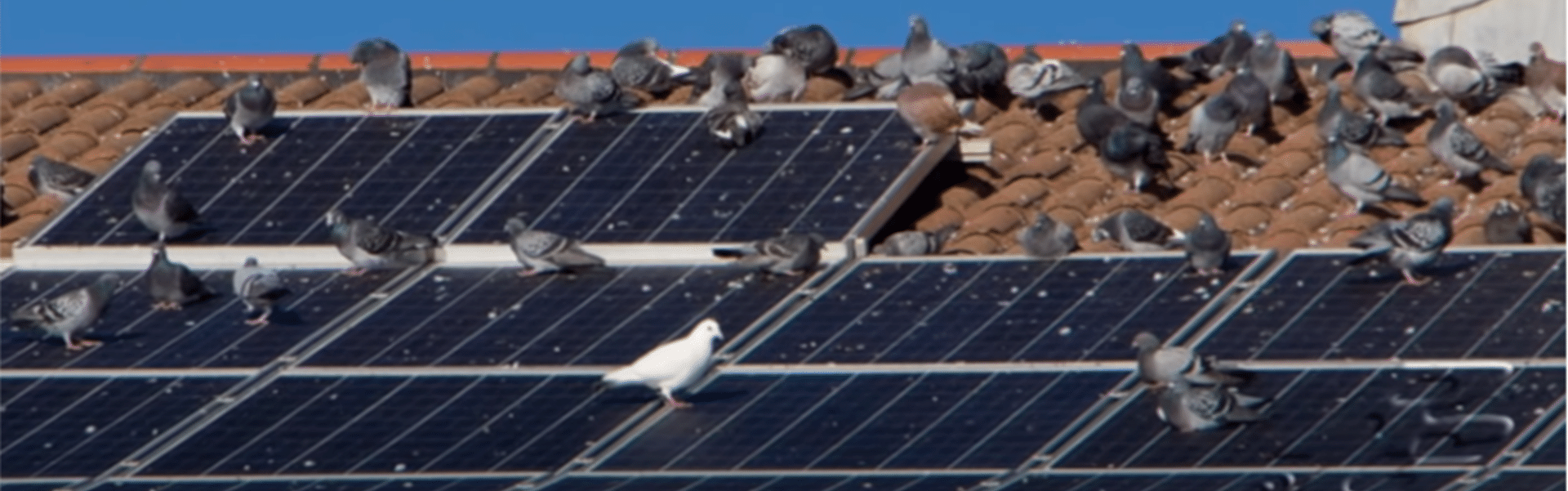
Most people realise they have pigeons under their solar panels within a few weeks of the birds arriving. Look out for:
- Cooing and scratching from the roof, especially at dawn and above top-floor bedrooms.
- Birds disappearing under the edge of the panels, often in pairs.
- Twigs, feathers and straw poking out from the sides of the array or collecting in gutters.
- Droppings on the panels, windows, cars, patio and window sills below.
- Overflowing gutters after rain, caused by nest debris and droppings washing off the roof.
- A drop in generation on your solar app or inverter, with no change in the weather.
Can pigeons damage solar panels?
Yes. Pigeons under solar panels don’t usually break the panels themselves, but they cause damage around and underneath them – and the longer they stay, the worse it gets.
Damaged cables and fittings
Birds pecking and nesting around the array can disturb or damage the cables and connectors beneath the panels. Electrical faults on a solar system need an installer to fix, which can be expensive.
Blocked gutters and damp
Nest material and droppings wash into gutters and downpipes. Blocked gutters overflow, which can lead to damp patches, stained walls and water getting into fascias and soffits.
Lower solar output
Droppings on the glass shade individual cells. Because panels are wired in strings, one heavily shaded area can pull down the output of several panels. Read more about how birds affect solar panel efficiency.
Health and hygiene
Pigeon droppings are acidic and can carry bacteria and fungi. Old nests also harbour bird mites, which sometimes find their way into lofts and bedrooms. Large build-ups of droppings should only be cleared with the right protective equipment.
How long do pigeons nest under solar panels?
Longer than most people expect. A feral pigeon pair usually lays two eggs, which hatch after around 18 days. The chicks then stay in the nest for roughly four to five weeks before they fledge – and the parents can lay a new clutch before the first chicks have even left. Feral pigeons can breed in any month of the year, with a peak from spring to late summer.
In practice, that means pigeons nesting under solar panels will not move out on their own. As long as the gap is open, they will keep raising chick after chick in the same spot, and their young may settle nearby too. Waiting for “nesting season to end” rarely works with feral pigeons.
For more detail, see our guide to pigeon nesting season in the UK and when you can remove a nest.
Send a few photos – we’ll reply with a free, no-obligation quote.
How to get rid of pigeons under solar panels
There is only one reliable way to get rid of pigeons under solar panels: remove what is already there, then block the gap so they can’t get back in. Here is how it works, step by step.
1. Check for active nests
Before anything is removed, the nests need checking. Nests with eggs or chicks are protected by law (see below), so the timing of the work matters. A professional will check this on the day and advise you if anything needs to wait.
2. Move the pigeons on and remove the nests
Adult pigeons are moved on humanely, and every nest, twig and piece of nesting material is taken out from under the array. Leaving debris behind just encourages the birds to return.
3. Clear the droppings and treat the area
Droppings and debris are cleared from under the panels, around the roof and from the gutters. The area is then treated with a biocide to kill bird mites and break down hardened guano.
4. Fit mesh around the array
Finally, solar panel bird mesh is cut to fit and clipped around the whole edge of the array, from the panel frames down to the roof. Nothing is drilled into your roof or panels, so your warranty is unaffected, and air and rain still pass straight through.
Once the gap is closed, pigeons may try to get back in for a few days, but they soon give up and move on.

Can you get rid of pigeons under solar panels yourself?
If your panels are on a low, easy-to-reach roof such as a single-storey extension or garage, and no birds have moved in yet, a DIY mesh kit can work. For most homes, though, it isn’t a safe or practical job:
- Working at height – most arrays are on the main roof, two or three storeys up. Falls from ladders and roofs are one of the most common causes of serious injury at home.
- Existing nests – a kit only closes the gap. If birds are already nesting, you need to clear and treat the area first, otherwise you trap nests, droppings and mites (or even birds) under the panels.
- The law – removing an active nest can be an offence, so you need to know what you are looking at before you start.
- Quality and fit – cheap kits often use thin mesh and plastic clips that sag or snap, and any gap left at a corner will let pigeons straight back in.
Our page on DIY kits vs professional pigeon proofing covers this in more detail.
What doesn’t work for pigeons under solar panels
Lots of products are sold to stop pigeons, but most are designed for ledges and window sills – not for the space under a solar panel.
- Bird spikes only stop birds landing on the top edge. Pigeons land on the tiles and walk straight underneath. See why bird spikes won’t stop pigeons nesting under solar panels.
- Fake owls and hawks may work for a day or two, but pigeons quickly learn they don’t move.
- Bird gel is messy on panels, attracts dirt and wears off.
- Ultrasonic devices have little evidence behind them – pigeons are not very sensitive to ultrasound.
- Loose netting draped over a roof sags and tears in the wind and leaves gaps at the edges.
Pigeons, nests and the law in England and Wales
All wild birds, including pigeons, are protected by the Wildlife and Countryside Act 1981. Under the Act, it is an offence to intentionally take, damage or destroy the nest of any wild bird while that nest is in use or being built.
Feral pigeons can only be controlled beyond that – for example, removing nests with eggs – under the general licences issued each year by Natural England in England and Natural Resources Wales in Wales. These licences only apply for specific reasons, such as preserving public health or public safety, and come with conditions, including showing that non-lethal methods have been considered first.
For homeowners, the simple rule is: don’t remove nests with eggs or chicks yourself. Proofing your panels is a non-lethal, humane solution – it simply stops pigeons getting under the array.
What to expect after your panels are proofed
Once the mesh is fitted, most homeowners notice the difference straight away: no more cooing at dawn, no more twigs in the gutters and no fresh droppings on the patio. A few pigeons may sit on the roof ridge or try the edges of the array for several days, but with no way underneath they gradually give up and move on.
The mesh itself needs no maintenance. Rain, leaves and air pass through it, and it is designed to last for many years on an exposed roof. If your panels ever need servicing, an installer can unclip a section of mesh and clip it back afterwards.
Every professional installation we carry out comes with a 10-year guarantee. If pigeons get back under your solar panels within that time, we return and fix it free of charge.
Pigeons under solar panels on rented and shared homes
If you rent your home, pigeons under the solar panels are normally the landlord’s responsibility to deal with, because they affect the structure and exterior of the property – especially when nest debris starts blocking gutters. Report the problem in writing and include photos. Our guide on who is responsible for gutters in a rental property explains landlords’ repair duties in more detail.
On terraces and estates, pigeons pushed off one roof often move straight to the next. If your neighbours also have solar panels, it can make sense to get them proofed at the same time – it is usually cheaper per home and stops the birds simply moving along the row.
How much does it cost to get rid of pigeons under solar panels?
Most homes pay between £350 and £1,200 to have pigeons removed and their solar panels proofed. The price depends on the number of panels, the height of the roof and access, and how much nest material needs clearing. Read our full guide to the cost of pigeon proofing solar panels.
We cover England and Wales – find your local page in areas we cover.
Pigeons under solar panels – FAQs
How do you get rid of pigeons nesting under solar panels?
Remove the nests and droppings, treat the area for mites, then fit mesh around the edge of the array so pigeons can’t get back underneath. Nests with eggs or chicks are protected, so the work needs to be timed correctly.
Do pigeons cause damage to solar panels?
They rarely break the glass, but they can damage cables and fittings under the array, block gutters with nest debris and reduce your panels’ output with droppings.
How long do pigeons nest under solar panels?
Indefinitely, unless the gap is closed. Each brood takes around 18 days to hatch and four to five weeks to fledge, and feral pigeons can breed all year round, laying again before the first chicks have left.
How can I protect my solar panels from pigeons?
Fit a rigid mesh guard around the whole edge of the array. If birds are already nesting, the nests must be cleared and the area treated first.
Will pigeons leave on their own?
Very rarely. Pigeons are loyal to nest sites and will keep returning to the gap under your panels for years.
Can I remove a pigeon nest from under my solar panels?
Not if it has eggs or chicks in it – that can be an offence under the Wildlife and Countryside Act 1981. Empty nests can be removed, ideally as part of proofing the panels so birds can’t rebuild.
Is it worth pigeon proofing solar panels?
For most homes, yes. Proofing costs far less than repairing damaged cables, gutters or fascias, and stops the noise, mess and lost generation for good.