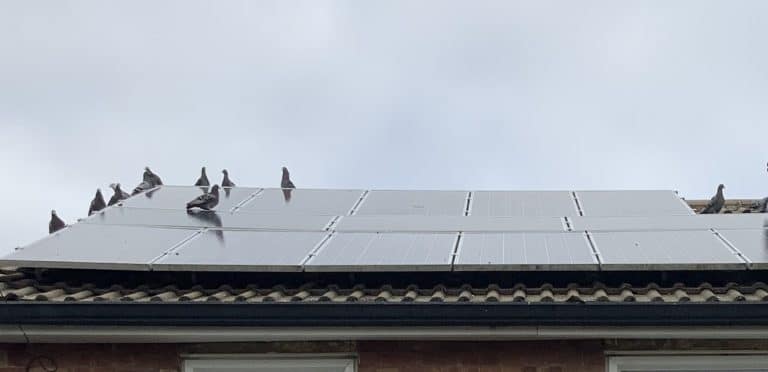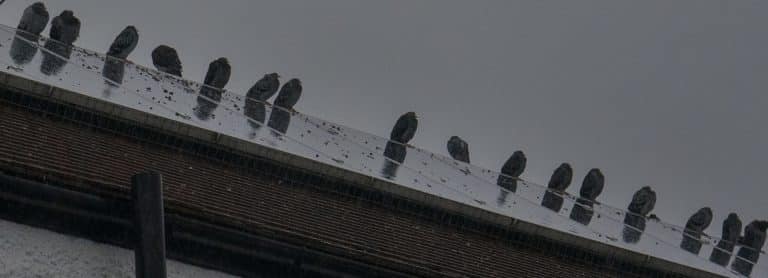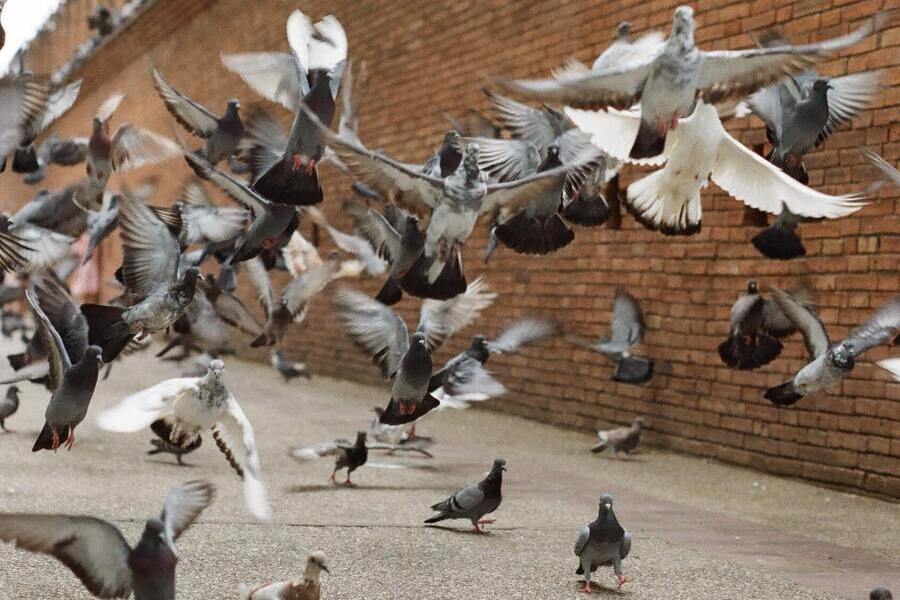
Pigeons on the roof can quickly go from a minor annoyance to a real problem – noise at dawn, droppings everywhere, blocked gutters and nests in the loft or under your solar panels. This guide explains why pigeons choose your roof, the humane ways to get rid of them, which deterrents actually work, and when it is time to call in a professional.
Key points
- Pigeons settle on roofs that offer food nearby, water, safe perches and sheltered nest sites.
- The best way to get rid of pigeons permanently is to remove what attracts them and block the places they nest.
- Humane deterrents such as spikes, post-and-wire, netting and mesh work when they are matched to the right spot.
- Poisoning pigeons is illegal, and nests in use are protected by law.
- On roofs with solar panels, the gap under the array is the number one nest site – proofing it solves most pigeon problems.
Why do pigeons sit on your roof?
If lots of pigeons are sitting on your roof, it usually means your home ticks one or more of their boxes. Feral pigeons need three things: food, water and somewhere safe to roost and nest. A roof near a good food source – bird feeders, bins, takeaways, a park where people feed birds – becomes a natural waiting point.
Roofs also offer plenty of perches and hiding places: ridge tiles, chimney stacks, aerials, satellite dishes, dormers, gaps under the eaves and, increasingly, the sheltered space under solar panels. Once pigeons start roosting on a roof, they leave droppings that signal to other pigeons that it is a safe place to be – so the numbers tend to grow.
The problems pigeons on the roof cause
- Noise – cooing, flapping and scratching from early morning.
- Droppings – acidic droppings stain walls, windows, cars and paths, and can damage roof materials over time.
- Blocked gutters – nest debris and droppings wash into gutters and downpipes, leading to overflows and damp.
- Damage – pigeons can dislodge flashing, block flues and vents, and damage cables under solar panels.
- Health and hygiene – droppings and old nests can carry bacteria, fungi and bird mites.
Feral pigeons or wood pigeons?
It helps to know which pigeon you are dealing with, because they behave differently.
Feral pigeons
Feral pigeons are the grey, blue-grey or mottled birds seen in town centres. They nest on buildings rather than in trees, often in groups, and can breed at any time of year. They are the species most likely to nest under solar panels, in roof voids and on ledges – and the most likely to build up into a colony on one roof.
Wood pigeons
Wood pigeons are larger, with a white patch on the side of the neck and white bars on the wings. They usually nest in trees and hedges, but on homes near parks, woodland or farmland they also nest under solar panels and on sheltered parts of roofs. They tend to come in pairs rather than flocks, and their peak breeding season is the summer months.
The good news is that the same humane solution works for both: remove what attracts them and physically block the places they nest.
How to get rid of pigeons on your roof
There is no single magic trick. The best way to get rid of pigeons is to combine three things: make your home less attractive, block the places they roost and nest, and use the right deterrent for each spot.
1. Remove food and water sources
Pigeons will tolerate a lot of disturbance if there is easy food nearby. Stop or move bird feeders (or switch to feeders that pigeons can’t use), keep bin lids closed, clear up fallen fruit and spilled seed, and cover water butts. It won’t solve the problem on its own, but everything else works better once the food supply has gone.
2. Block the places they nest
Nesting pigeons are much harder to move than roosting ones, so closing off nest sites is the most important step. Common roof hotspots include:
- Under solar panels – the most common nest site on modern homes. Fit solar panel pigeon proofing mesh around the array.
- Gaps under the eaves and soffits – repair or block with mesh or bird combs.
- Chimney pots and disused flues – fit a cowl or bird guard.
- Dormers, valleys and ledges – use spikes or post-and-wire.
- Loft openings and broken vents – repair and cover with mesh.
3. Use the right deterrent in the right place
Each deterrent works for a particular type of surface. Used in the wrong place, even a good product won’t help – see our honest guide to deterrents below.
4. Clean up droppings and old nests
Droppings and old nest material tell other pigeons a roof is safe. Once nests are no longer in use, clear them away and clean the area – wearing gloves and a mask for large build-ups, or using a professional.
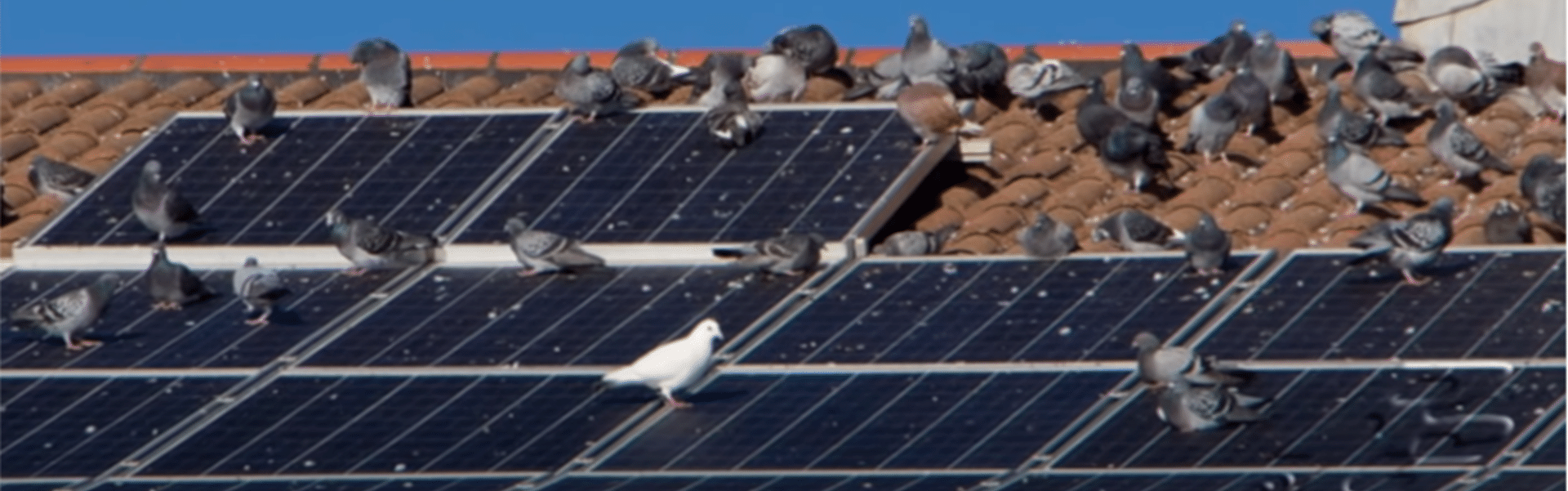
Pigeons under your solar panels? Send a few photos for a free quote.
Humane pigeon deterrents: what works and what doesn’t
If you want to get rid of pigeons without hurting them, these are the main options – rated honestly.
Bird spikes – good for ledges
Spikes stop pigeons landing on narrow ledges, parapets and the tops of signs. They are humane – they don’t pierce the birds – and work well on the right surface. They are not effective on open roof tiles or for gaps under solar panels, where pigeons simply land beside them. Read why bird spikes won’t stop pigeons nesting under solar panels.
Post-and-wire – good for ridges and long ledges
Thin, sprung wires held slightly above a surface make it uncomfortable for pigeons to land. It is discreet and suits ridges, parapet walls and long ledges.
Bird netting – good for enclosed areas
Properly tensioned netting is very effective for courtyards, balconies, light wells and loading bays. It must be fitted tightly with no gaps – loose netting draped over a roof sags, tears and can trap birds.
Mesh – best for solar panels and gaps
Rigid galvanised mesh is the best way to block gaps that pigeons nest in, especially under solar panels. It is clipped to the panel frames, so there is no drilling into the roof.
Scare devices – short-term only
Fake owls, hawk kites, reflective tape and spinning devices may move pigeons on for a few days, but pigeons quickly learn they are harmless. They are best used as a short-term measure alongside proofing.
Ultrasonic devices and gels – not recommended
There is little evidence that ultrasonic devices deter pigeons. Bird gels can work on small ledges but are messy, attract dirt and need replacing regularly.
Does WD-40 keep pigeons away?
No. Spraying WD-40 or oil on roofs and ledges is a popular tip online, but it doesn’t reliably deter pigeons, it can stain surfaces and roofing materials, and oily substances can harm birds’ feathers. It isn’t a solution we recommend.
How to get rid of pigeons naturally
If you prefer natural methods, focus on the things that make your roof less inviting rather than on sprays or remedies:
- Remove food sources and stop feeding birds near the house.
- Trim back trees that give pigeons easy access to the roof.
- Block nest sites physically with mesh, cowls and bird combs.
- Disturb roosting birds early, before they start nesting – pigeons are far easier to move before they have eggs.
- Use reflective or moving deterrents only as a short-term boost.
Natural methods work best when you start early. Once pigeons are nesting, the most reliable humane option is physical proofing.
What you can’t do: pigeons and the law
All wild birds in England and Wales, including feral pigeons, are protected by the Wildlife and Countryside Act 1981. It is an offence to intentionally take, damage or destroy the nest of any wild bird while it is in use or being built. Using poison against wild birds is also illegal.
Lethal control and removing nests with eggs is only allowed in specific circumstances under the general licences issued by Natural England and Natural Resources Wales, which include conditions such as considering non-lethal methods first. For homeowners, the safe and humane approach is always to deter and proof rather than harm. Find out more in our guide to pigeon nesting season and when you can remove a nest.
How to get a pigeon to leave your roof for good
To get rid of pigeons permanently, you need to take away their reason to stay. In practice that means:
- Find out where they are nesting – check under solar panels, eaves, chimneys and dormers.
- Wait until any nests with eggs or chicks are no longer in use, or ask a professional to check.
- Remove old nests and clean the area.
- Block the nest sites with mesh, cowls or bird guards.
- Add spikes or post-and-wire to favourite perches.
- Remove nearby food sources.
When pigeons can no longer nest on your roof, they rarely stay long.
When to call a professional
Many roof pigeon problems involve working at height, which is dangerous without the right equipment and training. It is worth calling a professional if:
- Pigeons are nesting under your solar panels.
- The nests are on the main roof, two or more storeys up.
- There is a large build-up of droppings to clear.
- The problem keeps coming back after DIY attempts.
We specialise in getting rid of pigeons under solar panels across England and Wales. We remove the nests, clear and treat the area and fit mesh around the array with no drilling – backed by a 10-year guarantee. Most homes pay between £350 and £1,200; see our pigeon proofing cost guide for details.
Find your local service in areas we cover.
Getting rid of pigeons on your roof – FAQs
What scares pigeons away?
Pigeons are briefly scared by sudden movement, predators and reflective objects, but they get used to them quickly. Removing food and blocking nest sites works far better in the long run than trying to scare them.
Does WD-40 keep pigeons away?
No. It doesn’t reliably deter pigeons, can stain roofing materials and may harm birds’ feathers.
How do you get a pigeon to leave?
Take away its reason to stay: remove food, clear old nests once they are no longer in use, and block the places it roosts and nests with mesh, spikes or post-and-wire.
What does it mean when there are lots of pigeons on your roof?
Usually that there is food nearby and somewhere sheltered to nest – often under solar panels, under the eaves or around a chimney. Lots of pigeons on a roof often means they are already nesting there.
What is the best way to get rid of pigeons?
A combination of removing food sources, blocking nest sites and using the right humane deterrent on each surface. For solar panels, mesh around the array is the most effective solution.
How do I get rid of pigeons without hurting them?
Use humane methods only: remove food, proof nest sites, and use spikes, post-and-wire, netting or mesh. Never use poison or glue, and don’t disturb nests with eggs or chicks.
Is it illegal to remove a pigeon nest?
It is an offence to intentionally take, damage or destroy a wild bird’s nest while it is in use or being built. Empty nests can be removed.