If pigeons are nesting on your roof, under your solar panels or on a balcony, you probably want to know two things: when will they stop nesting, and when can you legally remove the nest? This guide explains pigeon nesting season in the UK, how a pigeon nest develops, and what the law says about moving or removing pigeon nests in England and Wales.
Key points
- Feral pigeons can nest in any month of the year, with a peak from around March to July.
- Wood pigeons can also nest year-round, but most breed in the summer months.
- A pigeon nest is usually in use for around seven to eight weeks per brood – and pairs often lay again straight away.
- It is an offence to intentionally take, damage or destroy a wild bird’s nest while it is in use or being built.
- Empty nests can be removed. The best long-term fix is to block the nest site so pigeons can’t rebuild.
When is pigeon nesting season in the UK?
Unlike most garden birds, pigeons don’t have a short, fixed nesting season.
Feral pigeons
Feral pigeons – the town and city pigeons that nest on buildings – can breed in every month of the year. Breeding peaks between roughly March and July, but warm, sheltered nest sites such as roof voids and the gap under solar panels mean nests can be active even in the depths of winter.
Wood pigeons
Wood pigeons can also nest at any time of year, but their peak breeding season is through the summer months. The British Trust for Ornithology records first clutches being laid from late February through to August.
When do pigeons stop nesting?
For feral pigeons, the honest answer is that they often don’t. A pair can raise several broods a year and may lay a new clutch before the previous chicks have left the nest. If the nest site stays available, the cycle simply continues.
Activity usually slows down in late autumn and winter, which is why many people notice pigeons “disappearing” for a while – only for them to return to the same spot in spring. Waiting for pigeons to stop nesting on their own is rarely a solution.
How long does a pigeon nest stay in use?
A typical feral pigeon brood follows this pattern:
- Nest building – a loose platform of twigs, straw and feathers, built over a few days. Pigeons often reuse and add to the same nest.
- Eggs – usually two white eggs, laid a day or two apart.
- Incubation – around 17–19 days, shared by both parents.
- Chicks – the young (squabs) stay in the nest for roughly four to five weeks before they fledge.
- Next clutch – the parents may lay again when the chicks are only around three weeks old.
So each brood keeps a nest in use for around seven to eight weeks – and with repeat clutches, a nest can be active for most of the year. Wood pigeons follow a similar pattern, with chicks fledging at around 33–34 days.
What does a pigeon nest look like?
Pigeon nests are surprisingly scruffy: a flat, untidy pile of twigs, grass, straw and feathers, often sitting on a build-up of old droppings. Feral pigeons nest on flat, sheltered surfaces – ledges, roof voids, balconies and, very often, the gap under solar panels. Wood pigeons build a thin, flimsy platform of twigs, usually in trees and hedges.
Can you move or remove a pigeon nest?
All wild birds, including pigeons, are protected by the Wildlife and Countryside Act 1981. Under the Act, it is an offence to intentionally take, damage or destroy the nest of any wild bird while that nest is in use or being built.
In practice, that means:
- An empty nest that is no longer in use can be removed.
- A nest being built, or one with eggs or chicks, should be left alone.
- Moving a nest counts as taking it, so you can’t simply relocate an active nest somewhere more convenient.
General licences for feral pigeons
Feral pigeons can be controlled in more situations than most birds, but only under the general licences issued each year by Natural England (for England) and Natural Resources Wales (for Wales).
In Wales, General Licence 002 allows feral pigeon nests and eggs to be taken or destroyed only to preserve public health or public safety, or to prevent the spread of disease, and users must make reasonable efforts to use other lawful methods first. In England, feral pigeon control is covered by Natural England’s general licence for preserving public health and public safety. Both licences come with conditions, are renewed annually and can change from year to year.
Wood pigeons are covered by different licence rules. For homeowners, the simplest and safest approach is not to remove active nests yourself, and to use non-lethal proofing instead.
What happens if you destroy a pigeon nest?
Destroying an active nest without a valid reason under a licence is a criminal offence, and offences under the Wildlife and Countryside Act can lead to a fine and, in serious cases, a prison sentence. It also doesn’t solve the problem: if the nest site is still open, the pigeons will usually rebuild within days.
Send a few photos – we’ll reply with a free, no-obligation quote.
How to stop pigeons nesting – legally and humanely
The most effective approach is to work with the nesting cycle rather than against it:
- Act early – block likely nest sites before pigeons start building, or as soon as you see them carrying twigs.
- Check active nests – if there are eggs or chicks, wait until the young have fledged and the nest is no longer in use.
- Remove empty nests and clean up – clear nest material and droppings, and treat the area for mites.
- Block the site permanently – fit mesh, spikes or netting so pigeons can’t return.
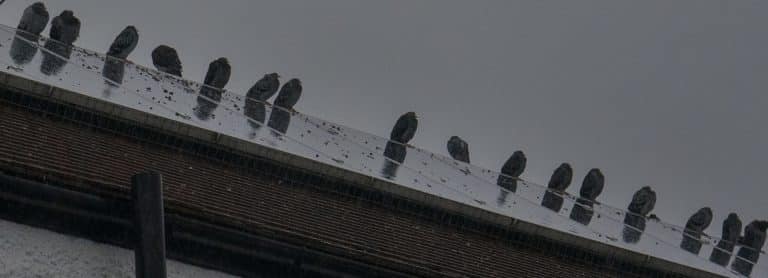
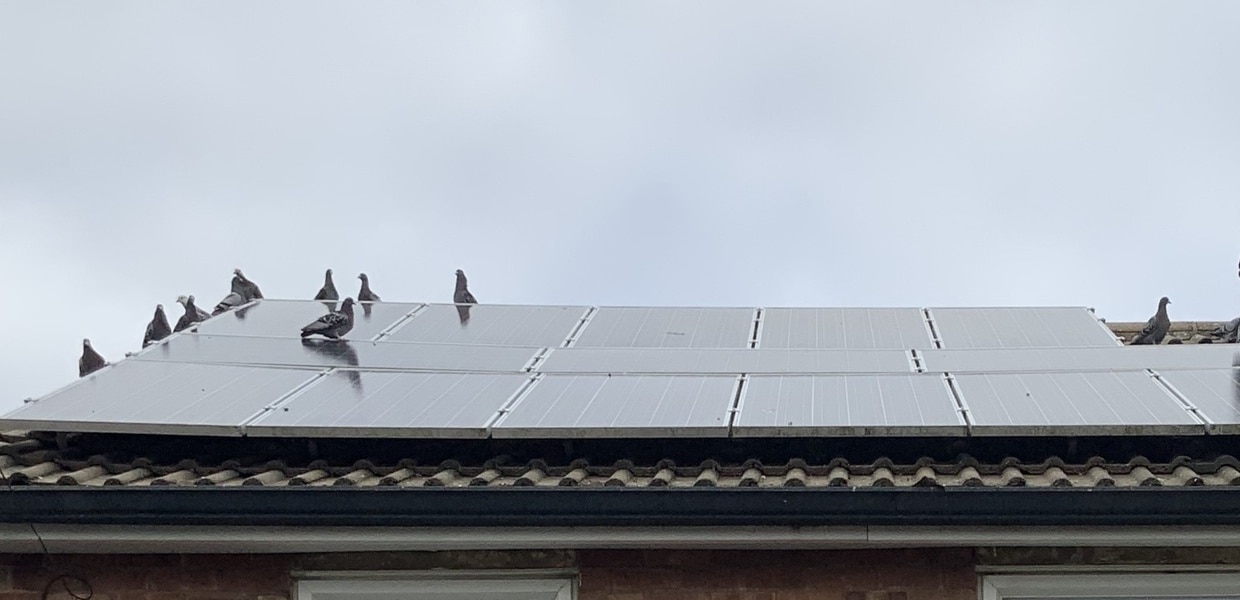
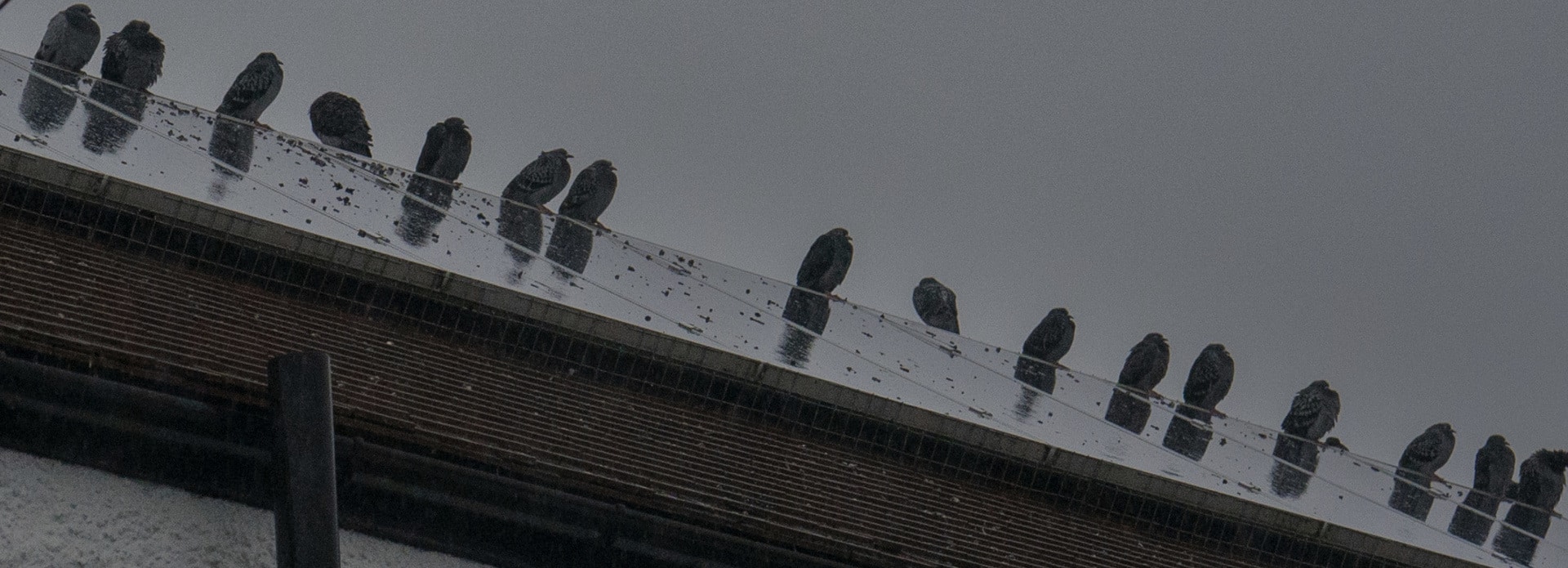
If pigeons are nesting under your solar panels, this is exactly what our solar panel pigeon proofing service does. We check for active nests, remove empty nests, clear and treat the area, and fit mesh around the array with no drilling. Read our full guide to getting rid of pigeons under solar panels, or see how to get rid of pigeons on your roof.
How long do pigeons nest under solar panels?
Pigeons can nest under solar panels all year round, and each brood takes around seven to eight weeks from egg to fledging. Because the gap under the array is warm and sheltered, nests there are often active even in winter. Once the young have fledged and the nest is empty, it is the ideal time to proof the panels.
Pigeon nesting season – FAQs
When is pigeon nesting season in the UK?
Feral pigeons can nest all year round, with a peak from about March to July. Wood pigeons can also nest in any month, but most breed in the summer.
When do pigeons stop nesting?
Feral pigeons often don’t stop as long as a safe nest site is available – activity simply slows down in late autumn and winter.
Can you move a pigeon nest?
Not while it is in use or being built – moving it counts as taking it, which is an offence under the Wildlife and Countryside Act 1981. Empty nests can be removed.
What happens if you destroy a pigeon nest?
Destroying an active nest without a licence is a criminal offence and can lead to a fine. The pigeons will also usually rebuild if the site isn’t blocked.
How long do baby pigeons stay in the nest?
Feral pigeon chicks usually stay in the nest for around four to five weeks before fledging. Wood pigeon chicks fledge at around 33–34 days.
Who can remove a pigeon nest legally?
Anyone can remove an empty nest. Removing nests with eggs is only allowed in limited circumstances under the general licences, so it is best left to a professional.