An off-grid solar system makes and stores all its own electricity, with no connection to the national grid. Panels charge a battery bank during the day, and an inverter turns that stored power into normal 230V electricity whenever you need it.
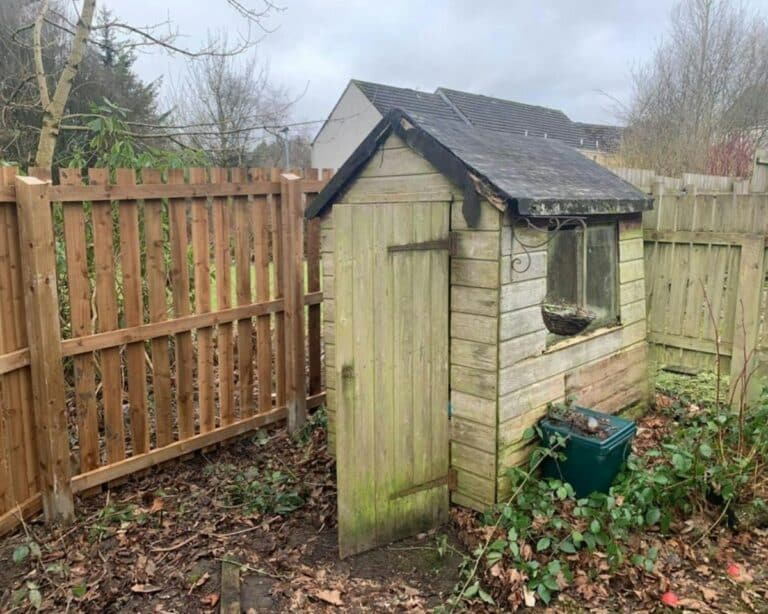
In the UK, off-grid solar is most often used for outbuildings, garden offices, workshops, stables, holiday cabins and remote properties where a grid connection would be expensive. This guide covers how it works, what you need, what it costs and whether it can realistically power a UK home all year.
Off-grid vs on-grid vs hybrid solar
The difference is whether the system is connected to the grid and whether it has a battery.
| System | Grid connection | Battery | Best for |
|---|---|---|---|
| On-grid (grid-tied) | Yes | No | Most UK homes: cuts bills, exports spare power |
| Hybrid | Yes | Yes | Homes wanting backup and more self-use of solar |
| Off-grid | No | Yes, essential | Sheds, workshops, cabins, remote buildings |
Most UK homes with rooftop solar are on-grid. Off-grid makes sense when a grid connection isn’t available, is too costly, or isn’t worth it for a small building.
What you need for an off-grid solar system
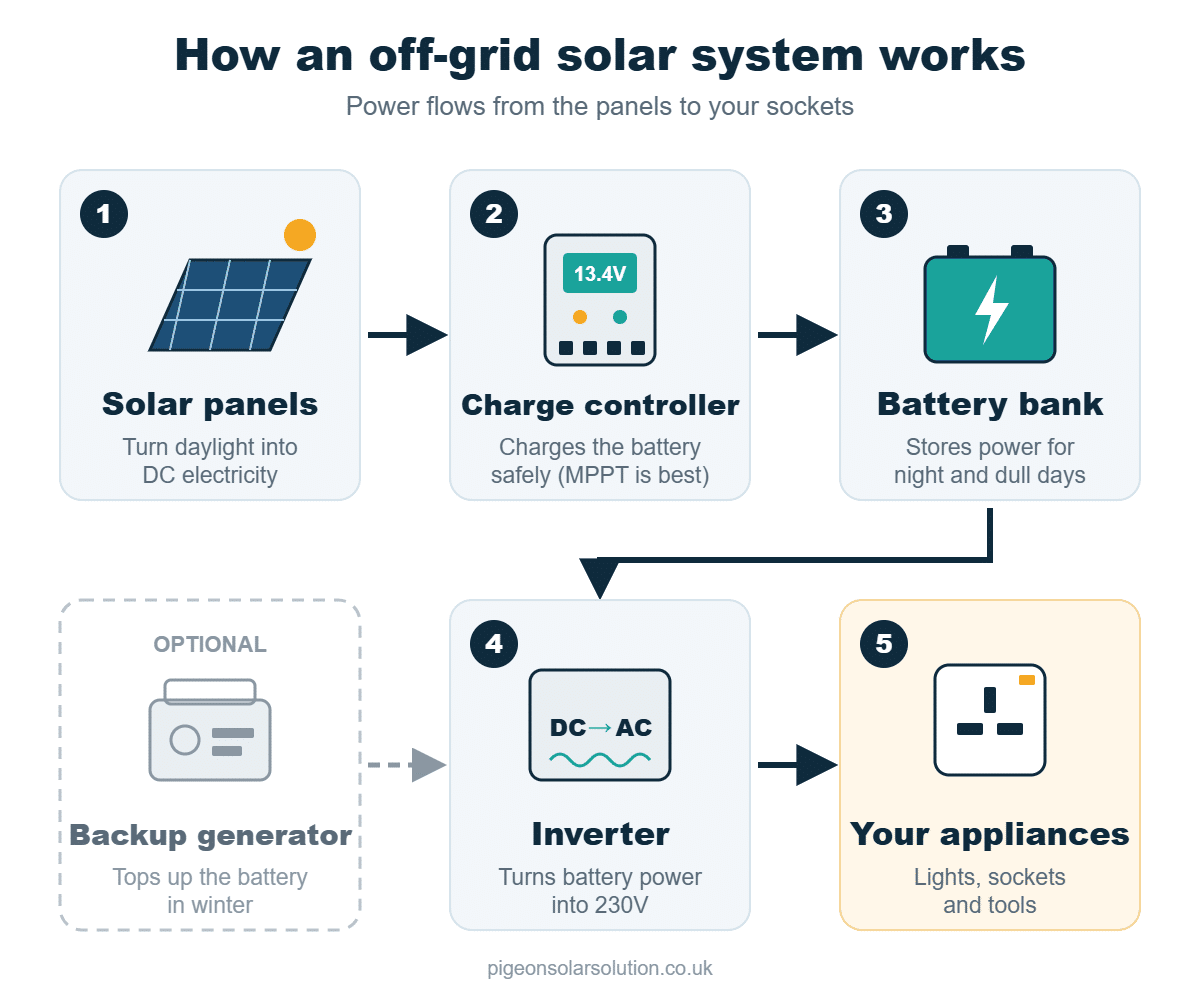
Every off-grid system has the same five core parts. Buying them as a matched kit avoids compatibility problems.
- Solar panels generate DC electricity in daylight.
- Charge controller (ideally MPPT) manages how the panels charge the batteries and stops overcharging.
- Battery bank stores the power for night-time and dull days. Lithium (LiFePO4) batteries last longer and can be drained deeper than lead-acid.
- Inverter converts the battery’s 12V, 24V or 48V DC into 230V AC for normal sockets. Larger systems often use an inverter-charger, which can also charge the batteries from a generator.
- Cables, fuses, isolators and mounts connect everything safely.
System voltage: small systems run at 12V; larger ones use 24V or 48V, which carries more power with thinner cables and less loss. Most systems over about 2kW are 48V.
How much does an off-grid solar system cost?
A small off-grid kit for a shed starts at under £500; a system big enough for a cabin or small home runs from about £6,500 to over £10,000. The battery is usually the biggest cost.
Start with your daily use. Ofgem estimates a typical British household uses about 2,900kWh of electricity a year (Ofgem), or roughly 8kWh a day. A workshop or garden office might use 1–3kWh a day. Size the battery to cover at least one to two days of use.
Product links are affiliate links: we may earn a small commission at no extra cost to you.
| Use | Kit | Battery | Price |
|---|---|---|---|
| Shed, lights and charging | 100W 12V Professional Off-Grid Solar Kit | 0.8kWh | from £474.39 |
| Workshop or garden office | 475W 12V Professional Off-Grid Solar Kit | 1.6kWh | from £923.01 |
| Cabin or stable block | 1900W 24V Professional Off-Grid Solar Kit | 5.0kWh | from £3,456.99 |
| Small home or holiday let | 3800W 48V Professional Off-Grid Solar System | 15.0kWh lithium | from £6,502.26 |
| Larger home | 4750W 48V Professional Off-Grid Solar System | 15.0kWh lithium | from £7,301.92 |
Prices as of November 2026 and vary by kit option. Browse the full range of off-grid solar systems at Sunstore, which also offers installation from £360.
Can off-grid solar power a UK home all year?
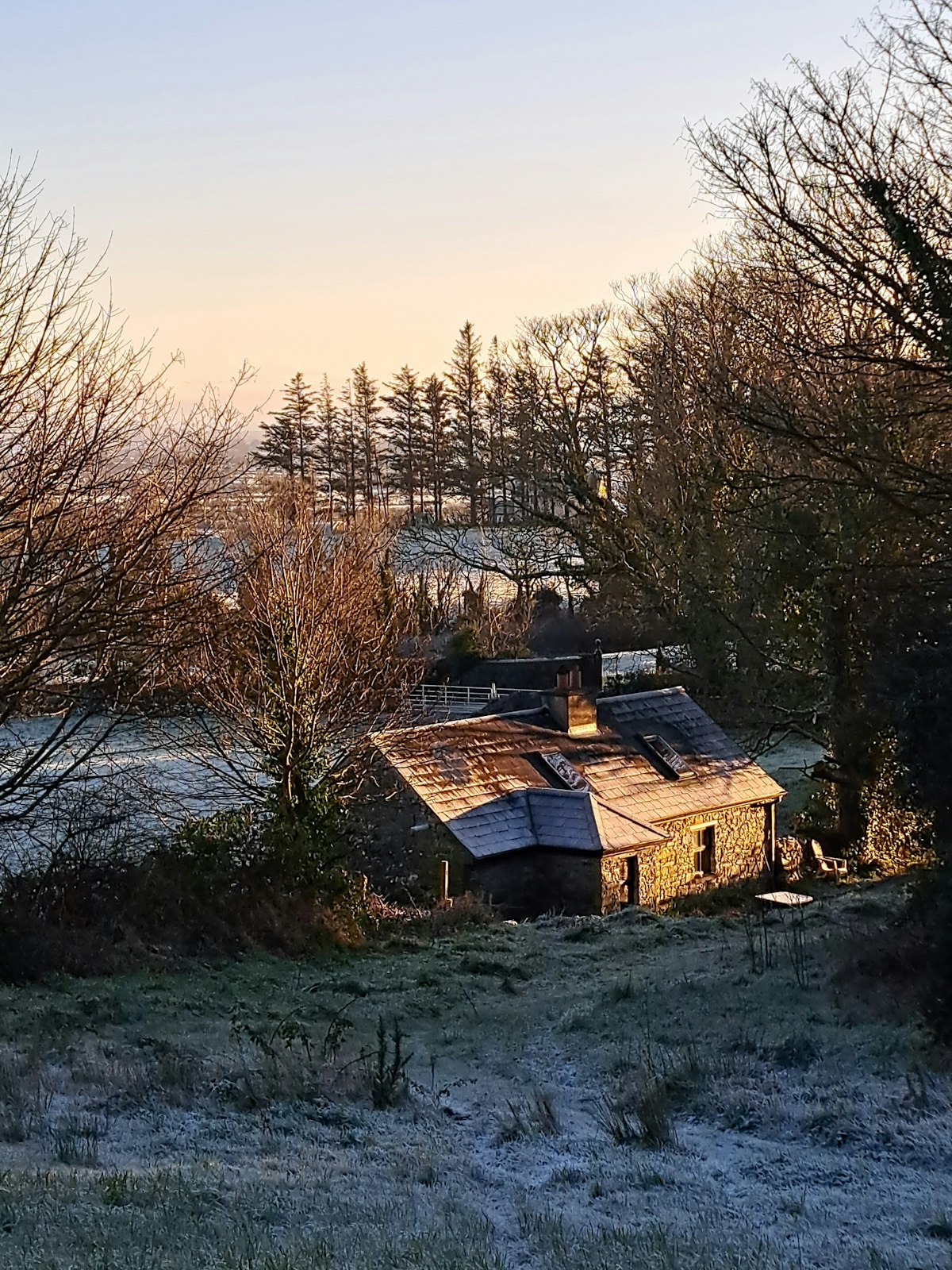
It can, but winter is the hard part. A UK solar system makes far less in winter: one example 6kWp system in Essex produced nearly 25kWh a day in May and July but only 4.9kWh a day in December (Sunsave). October to March typically produces just 25–35% of the year’s output (Good Energy).
To live fully off-grid through a UK winter, most people:
- oversize the panels, so even dull days produce enough
- add more battery storage to ride out several grey days
- keep a backup generator to top up the batteries in December and January
- cut winter demand, avoiding electric heating and using gas, wood or oil for heat
For outbuildings used mainly in spring and summer, none of this is needed; a modest kit covers it easily.
Rules and installation
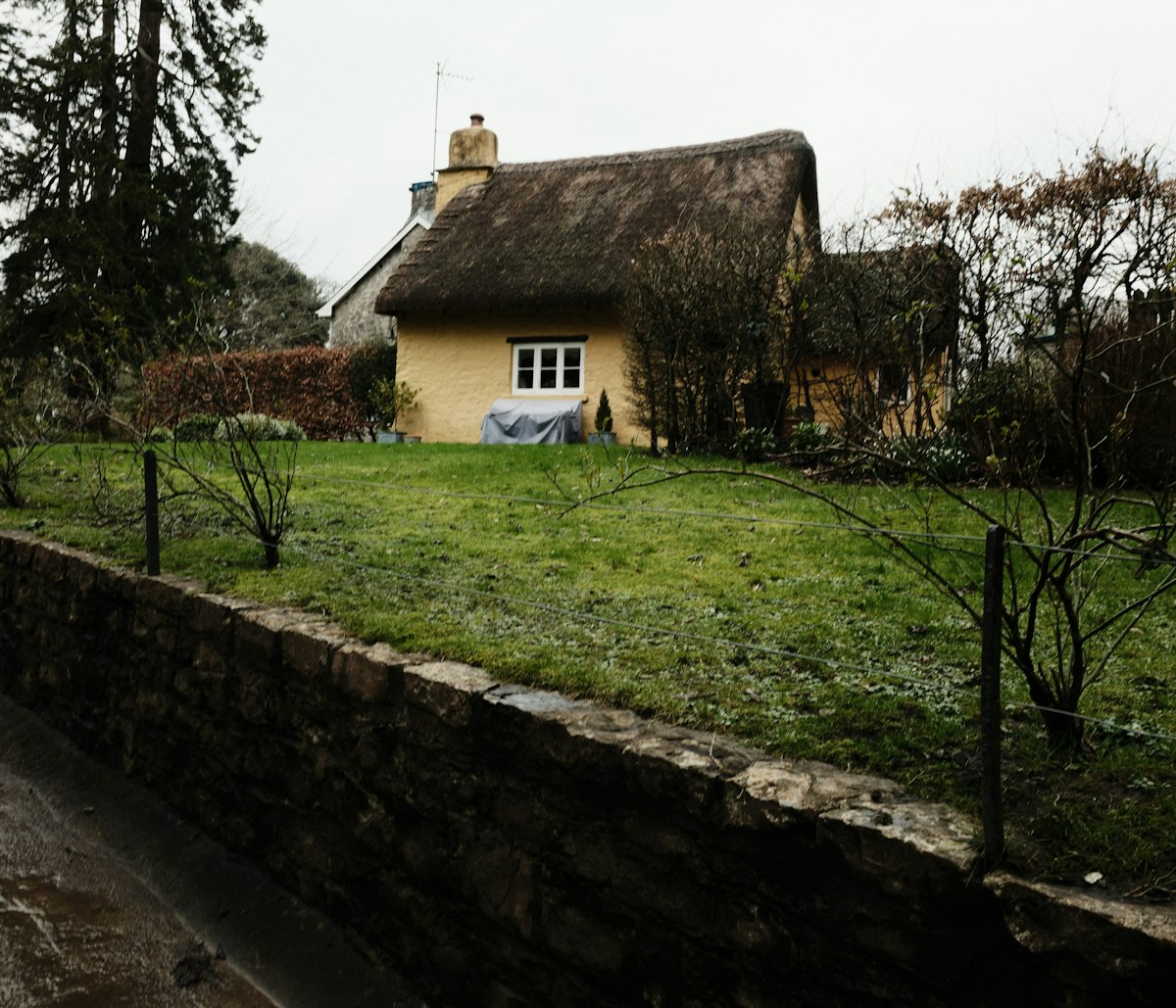
Panels on your home or on an outbuilding in its garden are usually permitted development in England, so you won’t need planning permission if they sit within 0.2m of the roof slope, stay below the highest part of the roof and the house isn’t listed (Part 14, Class A). Free-standing ground-mounted arrays have their own limits, including a maximum panel area of 9 square metres. Wales has separate rules (Welsh Government).
Small 12V kits are a common DIY job. Larger 24V and 48V systems store a lot of energy and need 230V wiring, so use a qualified electrician: new circuits are notifiable under Part P of the Building Regulations. For a shed project, see our step-by-step shed solar panel kit guide.
Protect your panels from pigeons
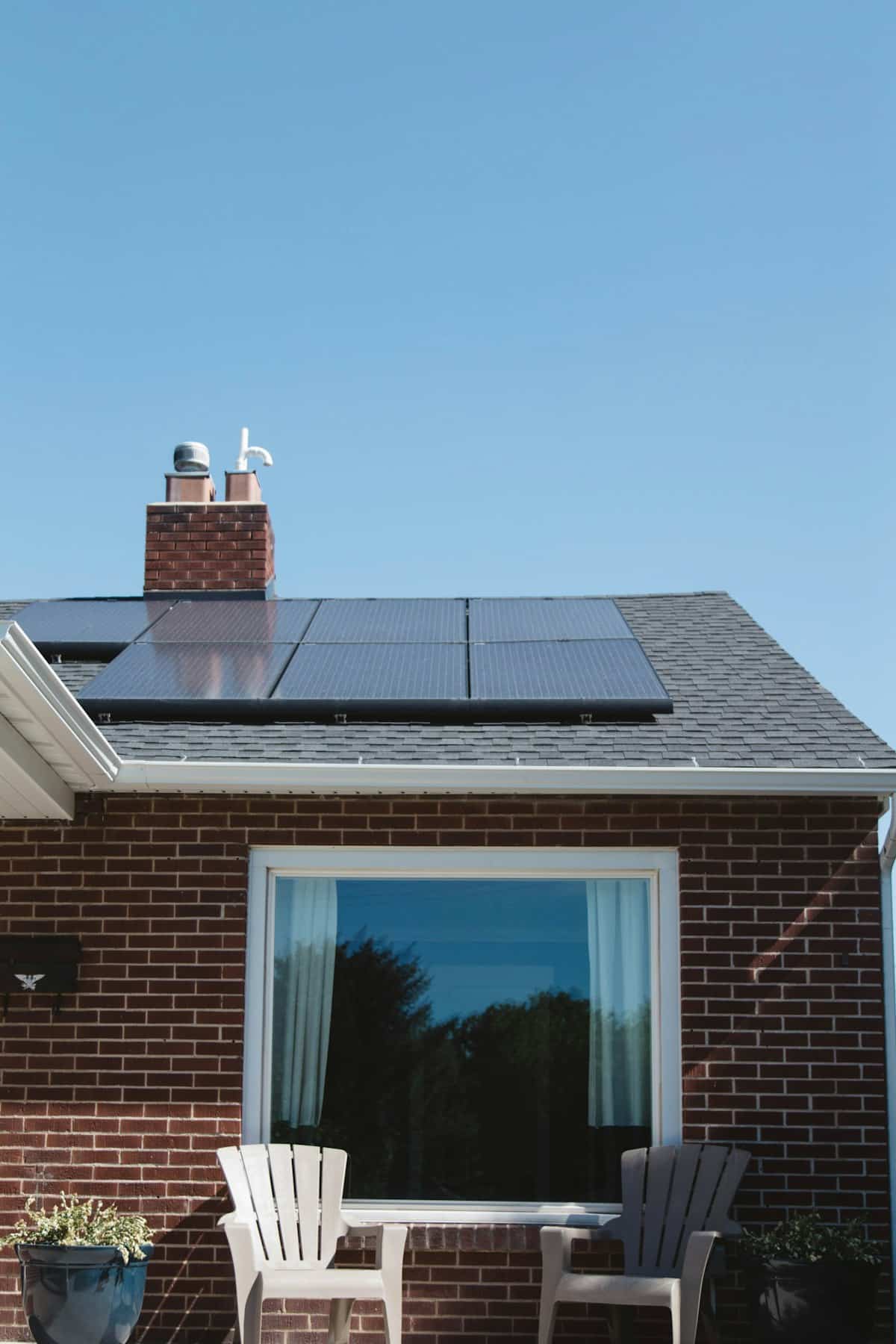
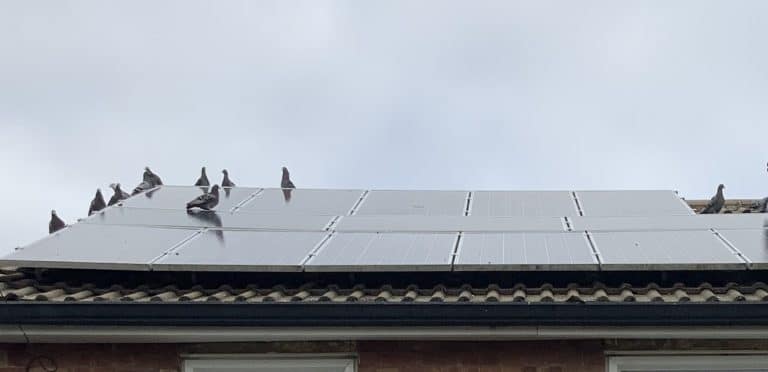
An off-grid system depends entirely on its panels, so anything that cuts their output matters more than it would on a grid-tied home. Pigeons love the sheltered gap under roof-mounted panels: their nests, droppings and debris can soil the glass, damage cabling and block drainage.
If you’re investing in off-grid solar on a roof, fit bird proofing from the start. Our solar panel bird proofing service fits a discreet mesh guard around the panel edge to keep pigeons out for good. See how much it costs.
FAQs
What is needed for an off-grid solar system?
Solar panels, a charge controller, a battery bank, an inverter, and the cables, fuses and mounts to connect them. A backup generator is worth adding for year-round use in the UK.
How much does a complete off-grid solar system with batteries cost in the UK?
At Sunstore, complete kits start from about £475 for a 100W shed kit and from about £6,500 for a 3.8kW system with 15kWh of lithium storage.
How does an off-grid solar system work?
Panels charge the batteries through the charge controller during the day. The inverter then draws on the batteries to supply 230V power whenever you need it, day or night.
Can I go completely off-grid with solar in the UK?
Yes, but you’ll need extra panels and batteries, or a backup generator, to get through December and January, when output can fall to a fifth of summer levels.
Do I need planning permission for off-grid solar?
Usually not for panels on a house or garden outbuilding in England, within permitted development limits. Check with your council for listed buildings and conservation areas.